
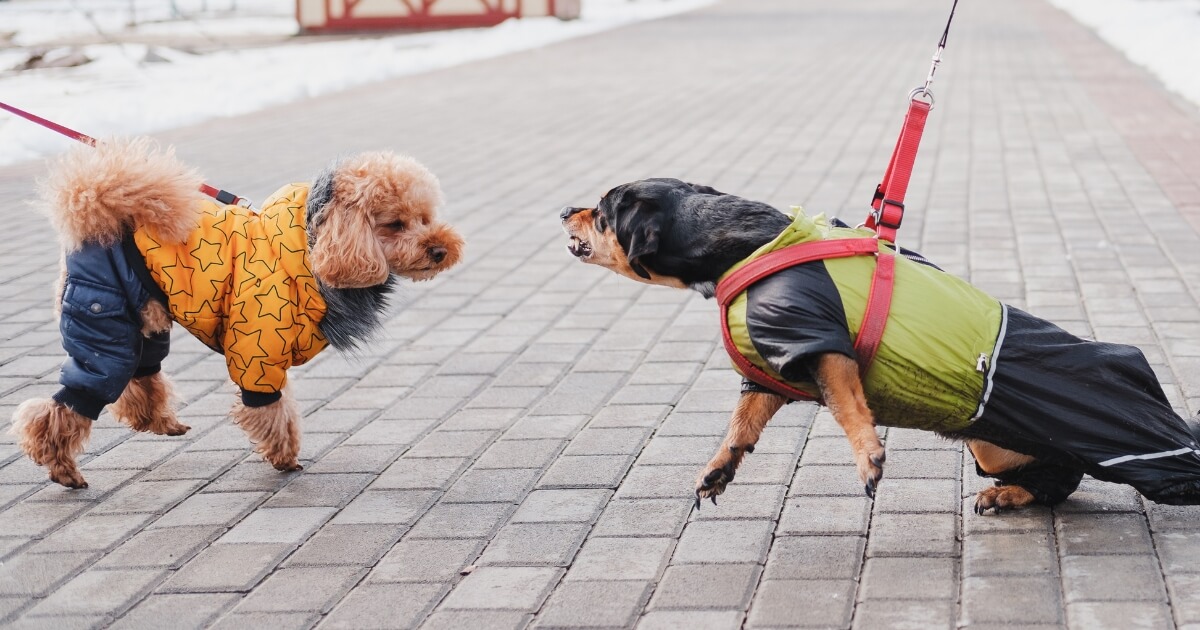
Is your dog aggressive, or is it something else?
If your dog lunges at the end of the leash, growls when a guest reaches for them, or snaps when someone gets too close to their food bowl, you have probably typed the word “aggressive” into a search bar late at night. You are not alone, and you are not a bad owner. Aggressive and reactive dogs are some of the most common cases our trainers see, and they are some of the most rewarding to work with.
Before anything else, it helps to know what you are actually looking at, because the plan depends on it. We use two words for two different problems.
Aggression is when a dog shows the threat of harm to a person or another dog. You see it as snarling, growling, snapping, biting, barking, or lunging. The reasons behind it vary: guarding territory, protecting a family member, guarding food or toys (resource guarding), fear, frustration, prey drive, or pain.
Reactivity gets confused with aggression all the time. A reactive dog overreacts to certain things or situations. It usually comes from fear, and it can be genetic, the result of too little socialization, or both. Reactive dogs often have specific triggers: men with beards or hats, small children, other dogs, or simply being on a leash.
A reactive dog can look every bit as scary as an aggressive one when they are barking and spinning at the end of the leash. Telling the two apart is one of the first things we do when you call us.
Safety first, before any training starts
While you are working on the problem, your first job is to keep everyone safe, including your dog. A few steps make a real difference right away.
- See your vet. Pain is on the list of causes for a reason. A dog who suddenly starts growling when touched, or who has changed seemingly overnight, deserves a checkup before anyone calls it a training problem.
- Manage the triggers you already know. If your dog goes off at the fence line when the neighbor’s dog walks by, keep them away from the fence for now. If they guard their bowl, feed them in a quiet room with the door closed. Every repeat of the bad moment makes the habit stronger.
- Give yourself distance on walks. Cross the street, turn around, or step behind a parked car. Walking at quieter times of day is not giving up. It keeps your dog under the level where they lose their mind.
- Do not punish the warning. A growl is information. A dog who learns that growling gets them in trouble can learn to skip the warning and go straight to the bite.
None of this fixes the aggression. It buys you time and keeps the problem from getting worse while you get real help.
What we mean by balanced training
You will hear a lot of opinions about how aggressive dogs should be trained. Our approach is balanced: clear communication, structure, and rewards, paired with fair and consistent correction when your dog makes a choice they know is wrong. The aim is a dog who behaves the same way on a busy sidewalk as they do in your kitchen, not only in a quiet training room.
For most aggressive and reactive dogs, the first missing piece is not a special trick. It is a common language. Your dog needs to understand what sit, down, place, heel, and off really mean, and needs to know you will follow through every time. When a dog understands what you are asking and trusts that the rules stay the same, a lot of the anxious guessing that drives reactivity starts to fade.
Balanced does not mean harsh. Many of our programs include the e-collar and leash, along with the coaching you need to use them properly. If you would rather train with rewards only, we also offer Basic Marker Mastery, a positive-reinforcement program with no e-collars or prong collars. We will talk through which approach fits your dog at your free consultation.
What honest results look like
Here is the part many trainers skip. No one can promise a complete fix for serious aggression toward people or other dogs, and anyone who does is not being straight with you. What training can do is give you control, so you can manage the behavior with confidence instead of dreading every walk.
In real life that looks like this: your dog notices another dog across the street and looks back at you instead of launching. A guest comes in and your dog goes to their place and stays there. You can take your dog on a walk around the neighborhood without scanning every corner for trouble. For a lot of families, that shift is the whole point.
Harley is a good example. She is an Australian Cattle Dog mix who came to her family as a rescue with a hard past, and at five years old she would react to any stranger who came within five feet. She lunged, barked, and pulled. Our trainer Tyla spent real time building trust with Harley first, then worked on her confidence out in public. Today Harley no longer lunges or pulls, and she waits for her cues. You can read Harley’s full story, and it shows why age and history do not rule a dog out.
Hobbes, a 1.5-year-old hound, had a family that described themselves as at a breaking point. Every noise, stranger, and dog set him off. After two weeks with our trainer Lauren, Hobbes walks through the world without reacting to it, and at home he is finally calm.
Two ways we help aggressive and reactive dogs
We have two main programs for these dogs, and both come with a free consultation first so we can assess your dog before recommending anything.
In-Home Aggressive Dog Training ($2,000, 8 lessons). The first four lessons are our basic obedience package: come, sit, down, place, loose-leash walking, and off. The last four lessons are built around your dog’s problem, working with you and your dog around other dogs in different scenarios. In-home lessons take place in your dog’s own world, whether that is your house, your yard, or the park and walking route you use every day. That matters for a reactive dog, because the triggers you need help with live on your street, not in a training building. See the full details on the In-Home Aggressive Dog Training program.
2-Week Board & Train ($3,150). Your dog stays with one of our professional trainers for two weeks of daily, structured training, and you get report cards with pictures and videos along the way. At pickup you receive a two-hour one-on-one session so you know exactly how to handle your dog at home. This is the route Hobbes took, and it works well for busy owners and for dogs who need a lot of repetitions in a short time.
The 2-Week Board & Train includes the e-collar and leash, and both programs end with you, not us, holding the leash. Payment plans are available. Call us today to learn more about payment options.
What you can start working on this week
While you set up your consultation, a few habits will make training go faster:
- Keep a simple trigger list. Write down what sets your dog off, where it happened, and how close the trigger was. Distance is one of the most useful things we learn at a first meeting.
- Practice a calm spot at home. Pick a bed or mat and reward your dog for lying on it while the house is quiet. Later it becomes the place they go when the doorbell rings.
- Hold the leash loosely when you can. A tight leash tells your dog something is wrong. Keeping distance from triggers is easier than holding them back.
- Stay consistent at home. Everyone in the house should use the same words and the same rules. Mixed messages keep an anxious dog guessing.
If your dog has bitten someone, or you are worried they might, do not wait on these steps. Call us and tell us what is going on.
Talk to our Charlottesville trainers
Our facility is on Seminole Trail in Ruckersville, just north of Charlottesville, and our trainers work with families across Central Virginia. If your dog’s behavior has you worried, you do not have to figure it out alone. Read more about how we approach aggressive dog training, or call (434) 205-9905 and tell us about your dog. We will be honest about what training can do and recommend the program that fits.